Construction of the Thai–Burma Railway
The Narrow Road to the Deep NorthThe construction of the Thai–Burma Railway was a military infrastructure project that made a strategic imperial ambition depend on the forced labor and lives of prisoners and civilians. Its route began as surveyors’ pegs and plans; its physical reality became rock cut by hand, lengthening shifts, illness, and death. The railway was completed, but the project’s purpose did not survive the war, and neither its memorials nor its surviving records could fully account for those who had built it.
Strategic Plan and Physical Route
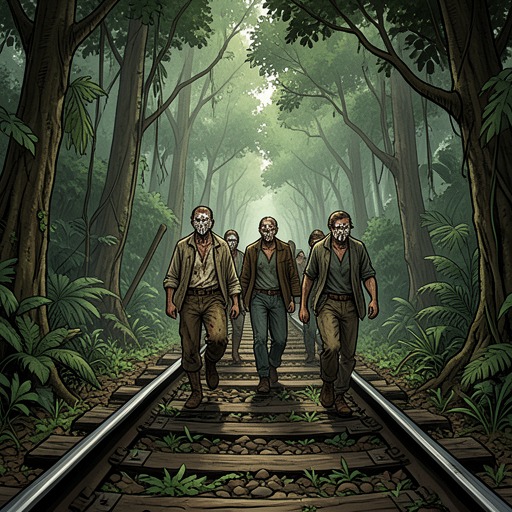
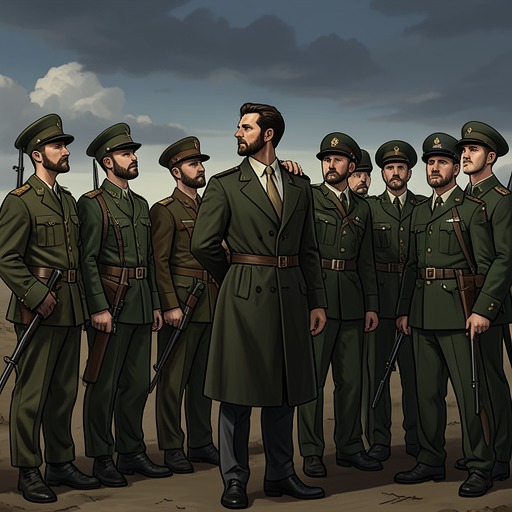
In early 1943, Dorrigo Evans stood at the head of a silent party of POWs and looked down at a line of pegs driven into the ground by Imperial Japanese Army engineers. The markers described a route of 415 kilometres, running from north of Bangkok through to Burma. At that point, the railway existed chiefly as a plan and an order: a proposed line whose scale seemed to exceed the available time, equipment, and resources.
The military urgency behind the project followed the changing course of the war. After the fall of Singapore on 15 February 1942, Japan’s position had expanded, but by 1943 the empire was overstretched and losing ground. The Allies were supplying the Chinese Nationalist Army through Burma, while American control of the seas limited Japanese movement by water. Japanese leaders sought a land route to supply their forces in Burma and pursue their ambitions against India. The Japanese Empire lacked the money, machinery, and time to build the necessary railway by ordinary means. Its faith in victory and the Emperor’s will instead supported a project made possible by coerced labor.
Deployment and Work on the Line
The first labor assigned to Dorrigo Evans’ J Force was to clear a kilometre of giant teak trees along the planned route. The prisoners were given blunt axes and rotten hemp rope. Their transfer to the work site had already exposed the conditions of their captivity: twenty-seven men were packed into each small, closed steel rice wagon, without enough room to sit. The journey lasted five days without food; three men died before the group was taken off the train at Ban Pong and crowded into trucks for the onward journey.
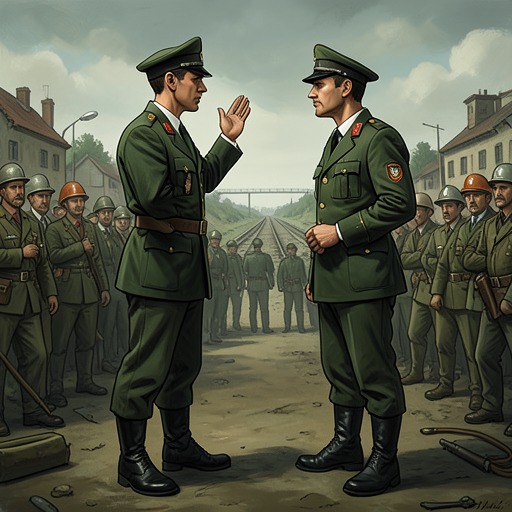
On the railway, prisoners cleared jungle, broke rock, shifted earth, and carried sleepers and rails with basic tools and their own physical labor. The project’s engineering demands could change even after work was well advanced. When a major cutting was half completed, the Railway Command Group ordered it enlarged by a third to address gradient problems in the next section. The revision required another 3,000 cubic metres of rock to be cut and removed. The prisoners lacked enough saws and axes for clearing, and they broke rock by hand with hammers and chisels. Their chisels blunted, while insufficient coke limited the ability to sharpen them in the forge. Nakamura asked for drilling machines and compressors, but the work proceeded within a system where the shortage of equipment was answered by demands on labor.
Quotas, Disease, and the Human Cost
The arrival of the monsoon marked a change in the work regime. As food diminished, the Speedo removed rest days, raised quotas, lengthened shifts, and increasingly required prisoners to work both day and night. It blurred the distinction between the fit and sick until camp conditions divided the men chiefly between the sick and the dying. A duck egg, a little palm sugar, a repeated joke, or a moment of hope could help the prisoners endure; none altered the labor demands imposed on them.
The relationship between quota-setting and survival was especially clear in the rock cutting. Tiny Middleton worked with a sledgehammer while Darky Gardiner held and turned the steel bar being driven into the rock. Tiny took pride in completing his quota first. As the Japanese engineers raised the daily requirement from one metre to two and then three, he continued to meet it rapidly. The others, many feverish, starving, or dying, tried to conserve enough strength to survive. Tiny’s exceptional pace became a standard others were expected to match, benefiting the Japanese work schedule at the prisoners’ expense. When the Speedo intensified, exhausted men were ordered back to the cutting for night work; the excavation measured six metres wide, seven metres deep, and half a kilometre long.
The figures reported during a cholera outbreak show how narrow the available labor pool had become. Of 838 POWs counted, 67 had cholera, 179 were in hospital with severe illness, and another 167 could manage only light duties. Sixty-two more reported sick that morning. Dorrigo Evans calculated that 363 men were available for railway work, but Nakamura demanded 500. The count came after four deaths the previous day and two overnight. A demand for a fixed workforce continued despite the accumulating evidence that illness and death had reduced the men able to work.
Completion, Abandonment, and Remembrance
The project drew on prisoners from beyond Evans’ J Force. Of 22,000 Australian POWs in Japanese captivity, 9,000 were sent to work on the railway. Alongside approximately 60,000 Allied POWs, a far larger number of Asian laborers were compelled to work: estimates include a quarter of a million Tamils, Chinese, Javanese, Malayans, Thais, and Burmese, or more. Estimates of Asian laborer deaths range from 50,000 to 200,000; the total is unknown. The account also describes Evans’ J Force as retaining its identity despite the deaths that reduced its members, its surviving men bound by a belief in one another and in their connection to the dead.
On 25 October 1943, steam locomotive C 5631 travelled the length of the completed Death Railway, towing three carriages of Japanese and Thai dignitaries. The remains of one in three of the Australians sent to the work lay along the route. After Japan’s defeat, the railway lost its military purpose and support. Japanese engineers and guards responsible for it were imprisoned or repatriated, and the remaining laborers maintaining it were freed. The Thais abandoned sections, the English dismantled them, and tribespeople pulled up and sold the rails. Rain and time eroded the banks, bridges, and cuttings; vegetation returned over the structures and the remains of the dead.
The railway’s afterlife exposes a sharp divide between what could be displayed and what remained uncounted. C 5631 was placed in the museum at Yasukuni Shrine in Tokyo, while its plaque made no mention of the deaths or the conditions under which the railway had been built. There was no agreed total for those who died on the project, and the names of many laborers had not been preserved in any comparable record. Decades later, short sections were cleared and made into tourist, sacred, or national sites. Yet the line itself had been dismantled or reclaimed, and the work that had cost so many lives left no enduring military achievement. Its completion records the realization of the plan; its ruin and the gaps in its commemoration reveal the human cost that the engineering record could not contain.